
Building a Stronger Digital Foundation for Siteman Cancer Center
Optimizing front-end architecture and Core Web Vitals across high-traffic patient journeys to dramatically improve site speed, usability, and performance.
77%
Increase in homepage performance score
75%
Faster First Contentful Paint (from 4.4s down to 1.1s)
3x
Performance score tripling across the majority of top patient pages
Services Provided


THE CHALLENGE
Overcoming Technical Bottlenecks on High-Traffic Patient Journeys
Siteman Cancer Center’s website serves as a critical resource for patients researching cancer diagnoses, exploring treatment options, finding providers, and accessing care.
As part of a broader website transformation initiative, Siteman Cancer Center sought opportunities to improve the performance and usability of its existing digital experience while continuing to invest in long-term modernization efforts. Performance testing revealed opportunities to improve speed and usability across several of the site’s most-visited pages.
Slow-loading experiences can create friction for users seeking important healthcare information and negatively impact accessibility, search visibility, and overall engagement. Siteman sought targeted improvements that would immediately enhance the user experience while supporting long-term digital goals.

High-traffic cancer research and provider search interfaces optimized for rapid mobile load performance.
OUR APPROACH
Targeted Asset Optimization Meets Rigorous Quality Testing
Modea’s engineering and quality testing teams analyzed front-end architecture to eliminate technical debt without requiring a full platform rebuild.
Identifying Performance Bottlenecks
Modea’s website development and quality testing teams analyzed Core Web Vitals and front-end architecture across the site’s highest-traffic pages. Conducted alongside ongoing digital product strategy work, the review uncovered a significant source of technical debt: a single, monolithic CSS file containing styles for nearly every page type was being loaded across the entire website, increasing page weight and forcing users to download unnecessary assets.
Modularizing CSS with Template-Based Delivery
Rather than pursuing a larger redevelopment effort, the team implemented a template-based loading strategy that delivered only the CSS required for the specific page template being viewed. Global styles were reduced to a smaller set of essential assets, significantly reducing unnecessary code and improving rendering efficiency while preserving the existing user experience and content structure.
Validating Speed Gains & Quality Assurance
Following implementation, Modea validated results through performance testing and quality assurance reviews, measuring improvements across key metrics including Performance Score, First Contentful Paint (FCP), Largest Contentful Paint (LCP), Speed Index, and Cumulative Layout Shift (CLS). This testing ensured technical enhancements translated into meaningful user experience gains while maintaining stability across devices and browsers.
- Template-Based Asset Delivery: Modularized global CSS files to serve page-specific styles dynamically.
- Core Web Vitals Audit: Evaluated FCP, LCP, Speed Index, and CLS to target rendering bottlenecks.
- Preserved UX & Content: Improved loading speeds without disrupting existing content management workflows.
- Rigorous QA Validation: Performed cross-browser and cross-device testing to guarantee stability.
Expertise & Capabilities Doc
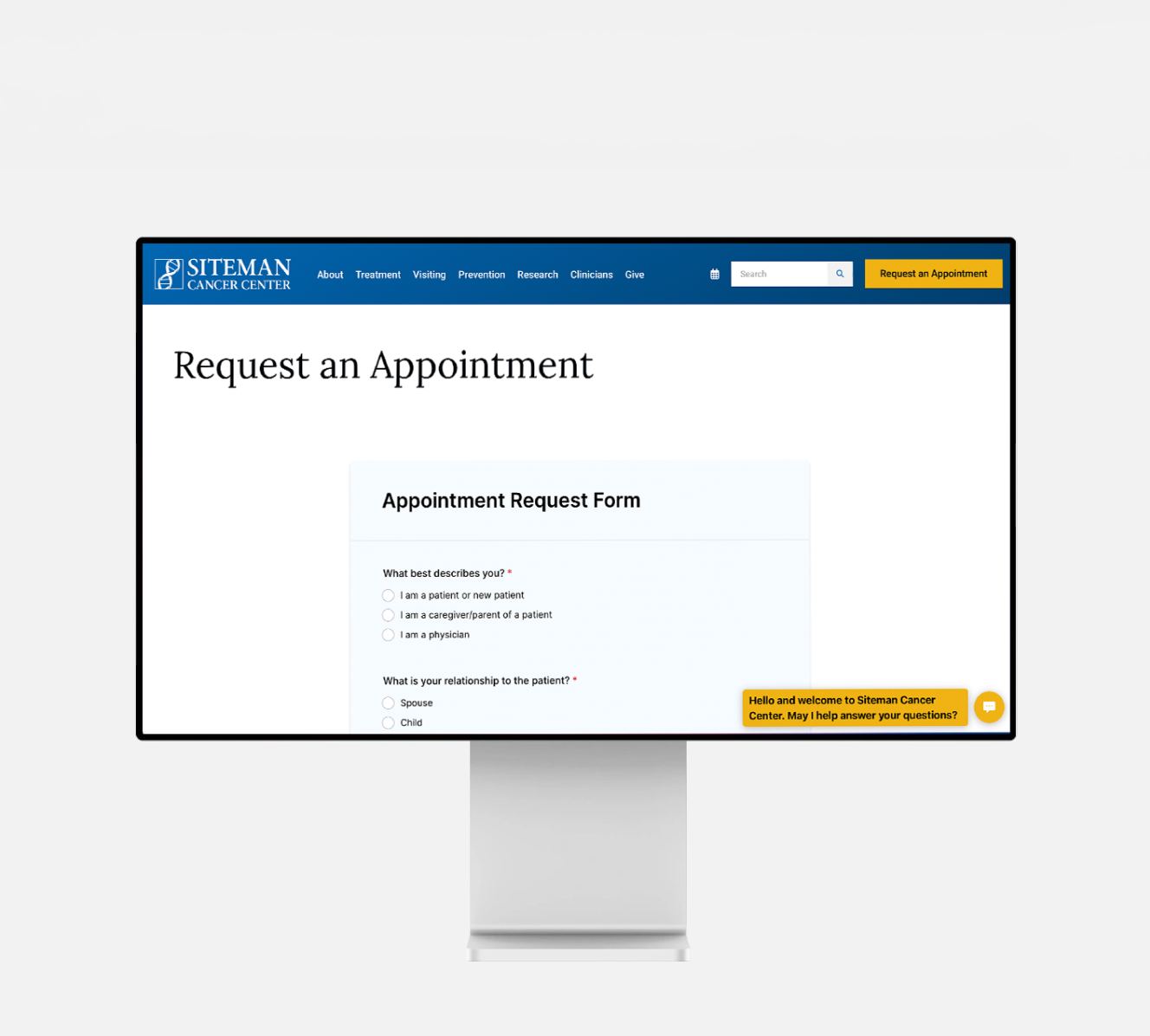

Structured clinical information pages paired with an accessible appointment request form to streamline the patient intake journey.
"The majority of our top pages saw their performance scores triple, while homepage First Contentful Paint improved from 4.4 seconds to 1.1 seconds."
— Modea Engineering Team
THE RESULTS
Measurable Impact on Page Speed and Core Web Vitals
The optimization delivered dramatic performance improvements across Siteman Cancer Center‘s highest-traffic patient journeys while requiring minimal development effort.

Multi-Page Performance Gains
Lifted performance scores across several top patient care pages from the 20s up into the 70s and 80s.

Dramatically Faster Page Rendering
Decreased Speed Index from 4.6s down to 1.4s and reduced Largest Contentful Paint (LCP) from 6.3s to 3.2s.

Reduced Visual Layout Shifts
Improved Cumulative Layout Shift (CLS) from 0.238 to 0.062, ensuring a stable, non-jarring visual experience as content loads.

Homepage Speed Acceleration
Boosted the homepage Performance Score from 44 to 78 and cut First Contentful Paint by 75% (from 4.4s to 1.1s).
TECHNOLOGY STACK
Built on High-Performance Systems Architecture

FAQs
What causes healthcare websites to load slowly?
Healthcare websites often accumulate years of content, integrations, and third-party tools. Over time, large CSS files, unused JavaScript, outdated plugins, and inefficient page templates can negatively impact performance. A performance audit can help identify bottlenecks and uncover opportunities to improve load times without requiring a complete website redesign.
How can healthcare organizations improve website performance without rebuilding their website?
Many performance gains can be achieved through targeted optimization efforts. These may include improving front-end architecture, reducing unnecessary assets, optimizing media delivery, refining page templates, and addressing code inefficiencies. In Siteman Cancer Center’s case, a template-based CSS loading strategy significantly reduced page weight and improved Core Web Vitals without requiring a full rebuild.
How does website performance affect SEO and AI visibility?
Search engines use page experience signals, including speed and Core Web Vitals, as part of their evaluation of website quality. Faster websites are generally easier for search engines to crawl and can contribute to stronger organic visibility. As AI-powered search experiences continue to evolve, organizations with fast, accessible, and technically sound websites are better positioned for content discovery and indexing.
How does Modea measure website performance improvements?
Modea combines performance testing, analytics, and quality assurance practices to evaluate the impact of technical enhancements. This may include Lighthouse testing, Core Web Vitals analysis, accessibility reviews, user behavior analysis, and ongoing monitoring. By pairing technical metrics with user experience data, organizations gain a more complete understanding of how website improvements affect real-world users.